Table of Contents
The Victoria and Albert Museum is one of the great museums of London — and one of the great museums of the world.
If the British Museum gives you civilisations through objects, the V&A gives you design, craftsmanship, style, interiors and artistic culture through things made to be used, admired, worn, displayed and lived with. The UK government describes it as the world’s largest museum of decorative arts and design, with a permanent collection of over 4.5 million objects, spread across 145 galleries and covering 5,000 years of art and design.
That scale is one of the reasons this museum is so rewarding with a guide.
It is also one of the reasons it is easy to underestimate.
Why the V&A matters
The V&A is not a museum of one medium.
It is a museum where sculpture, furniture, metalwork, jewellery, ceramics, fashion, silver, photography, architecture, books, prints, theatre, textiles and design all live under one roof. Britannica describes it as what is generally regarded as the world’s greatest collection of the decorative arts, and traces its origins back to the Museum of Manufacturers founded in 1852, with roots in the Great Exhibition of 1851.
That origin matters. This is a museum born not only from collecting, but from ideas about taste, making, industry and public education. It was named after Queen Victoria and Prince Albert, and Albert’s wider reforming and educational vision is part of the museum’s DNA.
So this is not just a beautiful museum. It is one of the places where Britain tried to teach itself how to look, how to make and how to improve the standard of design.
Why book this tour with a guide?
Because the V&A is so large and so varied that without structure it can become diffuse.
A good guide helps you avoid that. Instead of drifting through room after room and leaving with only fragments, you get a coherent route through the strongest parts of the museum. You begin to understand why one object matters, why one room feels so different from another, and why the museum is not simply a collection of beautiful things but a map of artistic culture across centuries and continents.
This is also one of those museums where the route can be shaped very intelligently around your interests. If you care most about Renaissance sculpture, British interiors, Tudor material, silver, Asian art or design history, the tour can lean in that direction.
What makes the V&A special
The great strength of the V&A is range with quality.
The government’s description of the museum highlights major strengths across Europe, North America, Asia and North Africa, and notes especially important holdings in sculpture, ceramics, furniture, textiles, jewellery, silver, photography, prints and books. It also notes that the museum’s Italian Renaissance sculpture collection is among the best outside Italy.
That is why the museum can feel almost inexhaustible.
For some visitors, it is the museum of sculpture.
For others, it is the museum of interiors and furniture.
For others, it is where design history becomes visible.
For still others, it is the museum of treasures you did not expect to find all in one place.
What you will see
A strong Victoria and Albert Museum tour usually focuses on the museum’s most famous highlights and on the galleries that best reveal what makes the V&A unique.
Depending on your interests, that often includes:
- the Cast Courts
- the Raphael Cartoons
- major European sculpture
- decorative arts and interiors
- Tudor and British historical material
- selected metalwork, silver or design collections
- key galleries that show the range of the museum
Because the collection is so large, this is one of the museums where a guided route makes an especially big difference.
The Cast Courts
The Cast Courts are one of the most distinctive things in the museum.
They are not just rooms of replicas. They are monumental teaching spaces filled with full-scale plaster casts of major works of European art and architecture, and they remain one of the great eccentric glories of the V&A. The V&A’s public pages continue to highlight the Cast Courts as a signature experience. The giant cast of Michelangelo’s David is one of the best-known objects there.
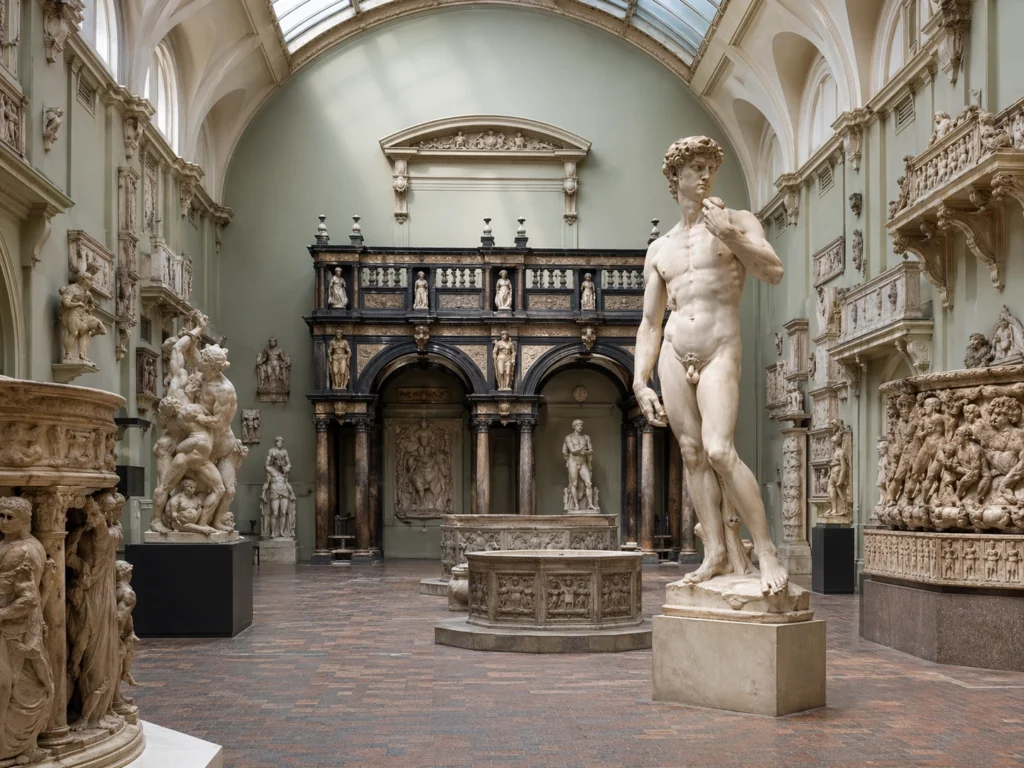
This is one of the places where the museum’s original educational mission becomes especially vivid: great art reproduced at scale so that people in London could study it directly.
The Raphael Cartoons
Another of the V&A’s defining treasures is the group known as the Raphael Cartoons.
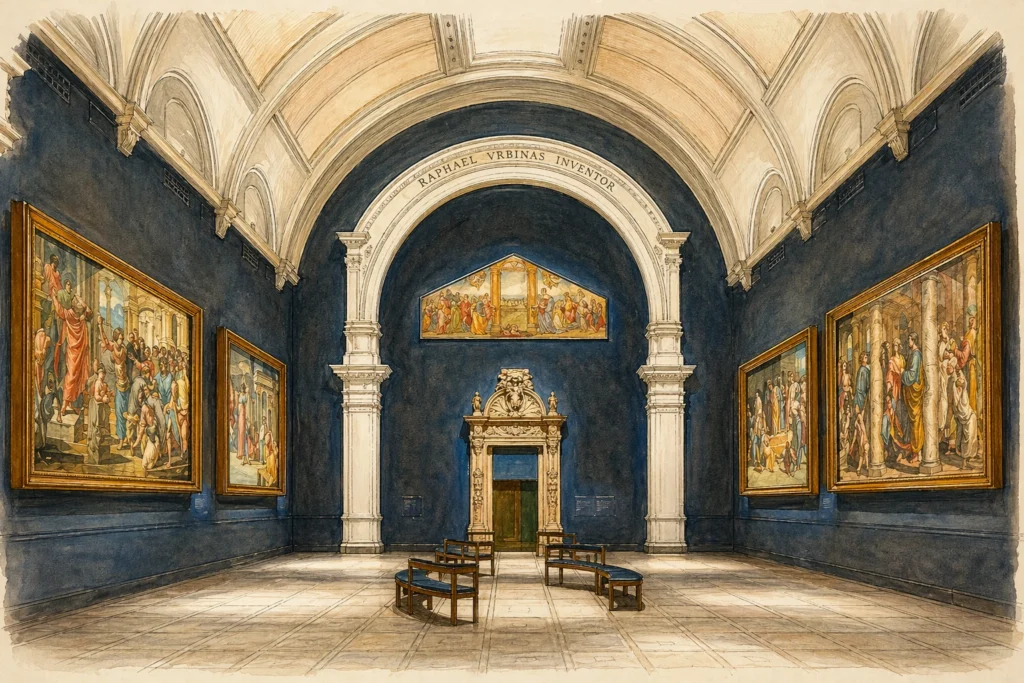
These are the surviving full-scale designs for tapestries intended for the Sistine Chapel, and the V&A / associated institutional descriptions identify them as one of the museum’s great artistic holdings. They are not “cartoons” in the modern comic sense, but monumental preparatory designs of very high status. The government summary of the museum notes that the seven surviving Raphael Cartoons are on display at the V&A on loan.
For many visitors, they are among the most impressive and least expected things in the museum.
Sculpture, design and British historical material
The V&A is especially strong in sculpture and in the decorative and domestic arts.
Government and reference summaries highlight the museum’s importance in sculpture, silver, furniture, textiles, ceramics and metalwork, with deep collections that extend far beyond a few famous showpieces.
That means the museum works unusually well for visitors who want to understand:
- how elite interiors were shaped,
- how objects signalled status,
- how European sculpture circulated,
- how taste changes over time,
- and how design reflects society.
Duration
The standard tour lasts around two and a half to three hours.
That is the right balance for this museum. It is long enough to make real sense of the collection, but short enough to keep the visit focused.
Start times
For this page, we are using the same practical museum schedule you are using across the site:
- 10:00 am — morning slot
- 2:00 pm
- 2:30 pm
- 3:00 pm — afternoon slots
This fits the museum’s standard public rhythm and works well for guided touring. The museum is free to enter, though some exhibitions require tickets.
Meeting point
The standard meeting point is outside the main Cromwell Road entrance.
The V&A’s official South Kensington access page states that the Cromwell Road entrance is step-free and is one of the principal public entrances.
We send the exact pin after booking.
Entry and exhibitions
Entry to the main museum is free, and the V&A states that you do not need to book for general admission. Some temporary exhibitions are separately ticketed. The museum also notes that disabled visitors receive discounted exhibition tickets and may add a free companion or carer ticket.
If there is a paid exhibition during your dates, we can discuss whether it is worth adding to your visit. As with the other big museums, the strongest format is often:
- guided tour of the main collection first
- then self-guided entry to the temporary exhibition afterwards
Accessibility
The V&A has strong access provision.
Its official South Kensington access page states that:
- the Cromwell Road entrance is step-free
- the Exhibition Road entrance is step-free
- the Tunnel entrance is not wheelchair accessible
- admission is free
- there are quieter visiting options and access arrangements for disabled visitors.
That makes the museum very suitable for wheelchair users and visitors with access needs.
Group size
For practical guiding quality, we recommend:
- up to 20 people: one guide
- above 20 people: split into multiple groups
That keeps the visit manageable in a museum with many rooms, many sightlines and a very broad route.
Tour Guide Systems
For groups of eight or more, we recommend our Tour Guide Systems.

The V&A is not always as noisy as the British Museum, but it is large and can be busy, and earpiece systems make the visit much smoother for larger groups.
We supply our own systems and can add them to your invoice.
Families and children
The V&A is not usually the first museum we recommend for very young children.
But for older children, teenagers, students of art or design, and adults who enjoy objects and interiors, it can be extremely rewarding. It is especially good for visitors who like to look closely and who want more than just the most famous tourist checklist.
Can this tour be customised?
Yes — very effectively.
Because the museum is so broad, this is one of the easiest tours to tailor. If you tell us in advance that your main interests are:
- Tudor Britain
- sculpture
- silver
- Asia
- design history
- interiors
- or decorative arts
we can shape the route accordingly.
Can it be combined with another museum?
In theory, yes. In practice, we usually recommend keeping it separate.
Because the V&A sits close to the Natural History Museum and the Science Museum, there is a natural temptation to combine them. It can be done, but it usually becomes heavy and superficial quite quickly. The strongest format is usually to let the V&A stand on its own.
If you want a lighter four-hour structure, a better combination may be:
- V&A + a short walk
- or V&A + Kensington continuation
rather than trying to cover two or three major South Kensington museums in one continuous stream of information.
Booking process
This tour should be booked in advance.
That is because:
- the museum is vast and benefits from a carefully planned route
- the best specialist V&A guides are fewer than people assume
- temporary exhibitions may need separate planning
- larger groups may require splitting or Tour Guide Systems
Once you send the enquiry, we confirm the date, start time and guide availability, then issue the invoice.
Final thought
The V&A is one of those museums that rewards the visitor not only with masterpieces, but with a way of seeing.
It teaches the eye to notice design, craftsmanship, material, elegance and cultural ambition. If you want one of London’s richest museums of making and beauty explained properly, this is the place.
Complete the enquiry form below to request your private Victoria and Albert Museum Tour.
FAQ
Is the V&A the largest museum of decorative arts and design in the world?
Yes. The UK government describes it as the world’s largest museum of decorative arts and design.
How many objects does the museum have?
The government summary gives the permanent collection as over 4.5 million objects.
How many galleries does it have?
The government summary states that the South Kensington site has 145 galleries.
Is entry free?
Yes. The V&A states that admission to the museum is free and you do not need to book, though some exhibitions are ticketed.
Where do we meet the guide?
At the main Cromwell Road entrance, with the exact pin sent after booking.
Is the Cromwell Road entrance step-free?
Yes. The V&A states that the Cromwell Road entrance is step-free and has a wheelchair accessible door.
What are the Raphael Cartoons?
They are the surviving full-scale designs for tapestries for the Sistine Chapel, and they are among the V&A’s great treasures.
Does the museum have Michelangelo’s David?
It has the famous full-scale cast in the Cast Courts, which are one of the museum’s defining attractions.
Is the V&A good for wheelchair users?
Yes. The museum has step-free entrances and strong access provision.
Should larger groups be split?
We usually recommend splitting groups above 20 people.
Do you recommend Tour Guide Systems?
Yes, especially for groups of eight or more.