Table of Contents
If Westminster Abbey is the royal church of Britain, then St Paul’s Cathedral is the great cathedral of the nation’s established Church.
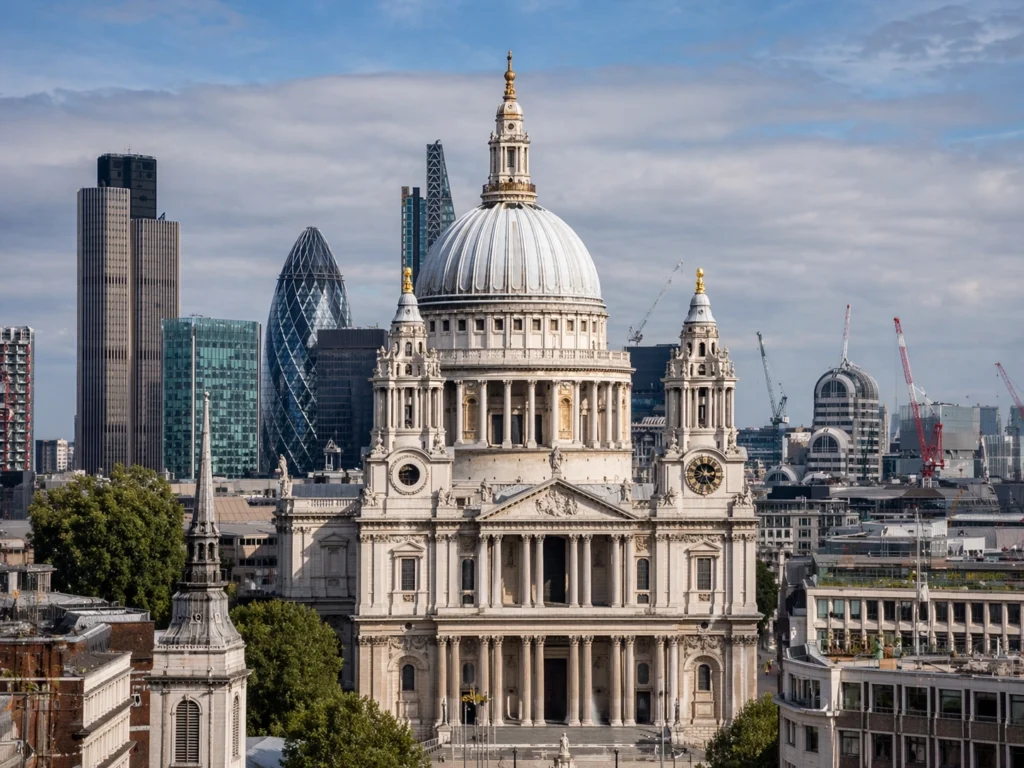
This is one of the most important churches in the country and one of the most recognisable buildings in London. It stands in the City of London, not in Westminster, and its great dome remains one of the dominant forms of the capital’s skyline. St Paul’s describes itself as the cathedral church of the Diocese of London and notes that there has been a cathedral dedicated to St Paul on this site for more than 1,400 years. The present building is the one designed by Sir Christopher Wren after the Great Fire of London.
In our own sequence of the five major London cultural visits, St Paul’s closes the core list: Westminster Abbey, Tower of London, National Gallery with National Portrait Gallery, British Museum, and finally St Paul’s Cathedral. It is a fitting conclusion, because it returns the visitor from museum culture and royal history to sacred architecture, music, memory and the life of London itself.
Why St Paul’s matters
St Paul’s is not only a beautiful building. It is a national stage.
If Westminster Abbey is where royal coronations and many royal ceremonies happen, St Paul’s has more often carried the weight of national thanksgiving, mourning and public state memory. It has hosted major services for figures such as Sir Winston Churchill and Baroness Thatcher, and it was the setting for the wedding of The Prince of Wales and Lady Diana Spencer in 1981. St Paul’s itself explains that its history includes state funerals, jubilees, thanksgiving services and major national occasions.
It also participates in London life a little more directly than Westminster Abbey does for many ordinary Londoners. Worship is free, concerts and services are part of the living rhythm of the cathedral, and St Paul’s remains a place people actively use, not only admire. St Paul’s official visit information says that it is always free to worship, while sightseeing is ticketed Monday to Saturday.
Why this tour is worth doing
St Paul’s is easier to underestimate than Westminster Abbey.
At first glance, many visitors think of it simply as “the cathedral with the dome”. But a guided visit helps you understand why the building matters so much:
- why Wren’s architecture was so important after the Great Fire;
- why the interior feels so unusually unified;
- why the Crypt contains some of Britain’s great state memorial burials;
- how the cathedral reflects the Anglican Church and the history of London;
- and how the Dome galleries change your understanding of the building.
This is also one of the great advantages of St Paul’s: unlike many medieval cathedrals built over centuries, this cathedral is unusually coherent because it is overwhelmingly the work of one architect, Christopher Wren. St Paul’s itself emphasises that the present cathedral was rebuilt after the Great Fire under Wren’s direction.
What makes the building special
The great dome is, of course, the first thing everyone notices.
But the building works because of more than the dome. The interior has a powerful sense of openness and unity. You do not feel as if you are moving through a heavily broken-up sequence of medieval spaces; instead, you feel the sweep of a great planned composition. That is one reason the cathedral can feel immediately legible even to first-time visitors.
The cathedral also gives you vertical variety that Westminster Abbey does not in the same way:
- the main cathedral floor,
- the Crypt below,
- and the Dome galleries above.
St Paul’s states that the Dome galleries include the Whispering Gallery at 257 steps, the Stone Gallery at 376 steps, and the Golden Gallery at 528 steps total. These are major highlights for many visitors, but they are accessed by stairs only.
What you will see
A well-structured St Paul’s Cathedral tour usually includes the main cathedral floor, the great narrative of the building, the principal monuments and the Crypt.
That normally means:
- the architecture of Sir Christopher Wren,
- the main cathedral interior,
- the Quire and liturgical heart of the building,
- the wider story of Anglican London,
- the Crypt,
- the tombs and memorials of major national figures,
- and, where open and desired, the option of climbing to the Dome galleries.
The cathedral’s access information states that the Cathedral floor, Crypt and Quire can all be reached without ordinary stairs, though access to the Quire uses a small electric stair lift and the Crypt is accessible by lift. The galleries, however, are stairs only.
Christopher Wren and the cathedral after the Great Fire
One of the strongest reasons to visit St Paul’s is to understand Wren.
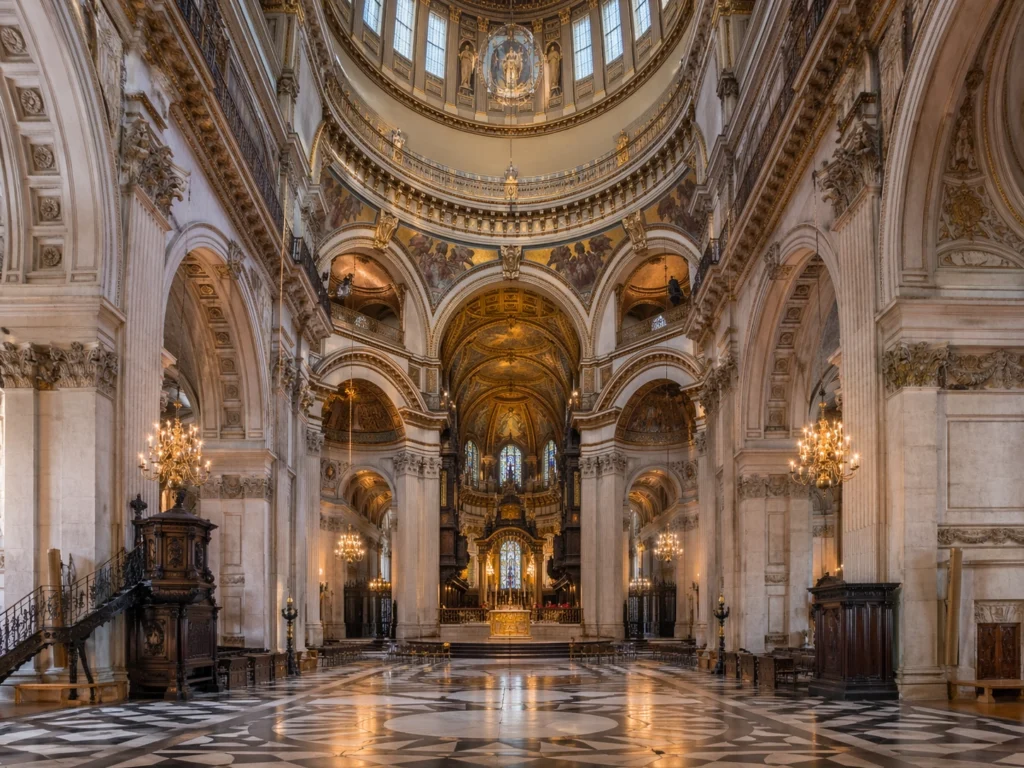
This cathedral is not just a famous church. It is one of the central architectural statements of post-Fire London. St Paul’s official history explains that the old cathedral was destroyed in the Great Fire of London in 1666, and that the present cathedral was then built under Wren. That historical moment matters enormously: the cathedral is both a religious building and a symbol of London remade.
Wren himself is also buried in the cathedral. That makes the building especially satisfying from a historical point of view: the architect did not merely design it, he rests within it.
The Crypt and the great burials
The Crypt is one of the essential parts of the visit.
This is where St Paul’s becomes not only a church but also a national memorial space. The cathedral is the burial place of Admiral Lord Nelson, the Duke of Wellington, and Sir Christopher Wren. These names alone are enough to make the Crypt historically central, but a guide helps you understand why they are there and what their presence means in the larger British story. St Paul’s official visitor pages and history material highlight the cathedral’s role in national remembrance and major memorial occasions.
For many visitors, the Crypt is what makes St Paul’s feel more public and state-oriented than Westminster Abbey, which is more closely associated with monarchy and coronation.
The Dome galleries
For many guests, climbing the Dome is one of the most memorable parts of the visit.
St Paul’s states that:
- the Whispering Gallery is reached by 257 steps,
- the Stone Gallery requires an additional 119 steps,
- the Golden Gallery requires another 152 steps from the Stone Gallery,
- and there is no lift access to the galleries. It also recommends that visitors with mobility difficulties, concerns about heights or confined spaces, or relevant medical conditions should not attempt the climb.
This means the Dome is a wonderful option for many visitors, but not for everyone. It is best described as manageable for many reasonably mobile visitors, but absolutely not step-free.
Photography and filming
St Paul’s official photography policy says that visitors are welcome to take non-flash still photography for personal, non-commercial use during sightseeing hours, Monday to Saturday. Photography is not allowed during services, and occasionally temporary no-photography areas may be designated. Photography is allowed on the Cathedral floor, in the Crypt, and on the Stone and Golden Galleries, but not on the Whispering Gallery for health and safety reasons.
As with the rest of your site, we also ask guests not to film or photograph the guide closely without first asking permission.
Accessibility
St Paul’s has strong accessibility support, though not everything is equally accessible.
The cathedral’s official accessibility page states that:
- the North Transept entrance is the recommended step-free entrance,
- wheelchair users can access the Cathedral floor,
- the Crypt is accessible by lift,
- the Quire is accessible by a small electric stair lift,
- wheelchairs are available on request,
- accessible toilets are available in the Crypt,
- and assistance dogs are welcome.
However, the galleries are stair-only, and the Triforium tour has no lift access either.
So the fairest summary is:
- the main church and Crypt are accessible,
- the Dome is not.
Duration
The usual duration is around two to two and a half hours.
That is enough time to understand the building, the main stories, the Crypt and the broader significance of the cathedral without making the visit feel heavy. It is also a slightly lighter museum-church experience than Westminster Abbey or the British Museum, which is one reason it makes a good closing point in our core London cultural sequence.
Start times
St Paul’s states that it is open for sightseeing Monday to Saturday, with doors opening on most days at 8.30 am on Monday, Tuesday, Thursday, Friday and Saturday, and 10.00 am on Wednesdays. It says last entry for sightseeing is usually 4.00 pm, with sightseeing ending 30 minutes later. Dome galleries usually open at 9.30 am (or 10.00 am on Wednesdays) with last entry at 4.15 pm. Opening times can change, so the daily calendar should always be checked.
Our standard tour timings are therefore:
- 10:00 am — morning slot
- 2:00 pm
- 2:30 pm
- 3:00 pm — afternoon slots
These timings work well within the cathedral’s current sightseeing pattern.
Meeting point
For this tour, the standard meeting point is at the statue of Queen Anne directly in front of the main west front of the cathedral.

That is the most practical and recognisable place to begin. We send the exact pin after booking.
The cathedral’s official postal address is:
St Paul’s Cathedral
St Paul’s Churchyard
London
EC4M 8AD
Group size
For this tour, we usually recommend:
- up to 20 people: one guide
- above 20 people: split into more than one group
This is the same practical approach we use for the major church interiors where audibility and sightlines matter.
Tour Guide Systems
For groups of 10 or more, we recommend our Tour Guide Systems.
Even though St Paul’s is less crowded than the British Museum or some parts of Westminster Abbey, the acoustics and scale of the building make earpiece systems very useful for larger groups.
We supply our own systems and can add them to your invoice.
Facilities
St Paul’s visitor information states that the Crypt Café by Benugo is open daily and can be entered directly through the north west Crypt door, with no ticket required. The cathedral also has a shop and visitor facilities.
Can this tour be extended outside the building?
Sometimes, yes.
If time allows and if your group is moving efficiently, the guide can sometimes add a brief exterior explanation around the cathedral precinct, including the urban setting of St Paul’s within the City of London and nearby historic points. But the standard product is the cathedral interior itself.
Can this be combined with another visit?
Yes, but selectively.
Because St Paul’s is a slightly shorter visit than Westminster Abbey or the British Museum, it can sometimes be combined sensibly with:
- a short City of London exterior continuation,
- or, in some cases, another cultural visit as part of a bespoke full day.
That said, the standard page here is for the standalone cathedral tour.
Booking process
This tour should be booked in advance.
That is because:
- opening times can vary by day,
- some areas may close temporarily,
- gallery access depends on conditions,
- and we need to match you with the right guide.
Once you send the enquiry, we confirm the date, start time and guide availability, then issue the invoice.
Final thought
St Paul’s Cathedral is one of the great spaces of London.
It combines architecture, religion, national memory and one of the most recognisable city skylines in the world. If Westminster Abbey gives you the royal church, St Paul’s gives you the national cathedral.
Complete the enquiry form below to request your private St Paul’s Cathedral Tour.
FAQ
How long does the tour last?
Usually around two to two and a half hours.
Is St Paul’s in Westminster?
No. St Paul’s Cathedral is in the City of London.
Is St Paul’s the same kind of church as Westminster Abbey?
No. Westminster Abbey is the royal church and coronation church. St Paul’s is the cathedral church of the Diocese of London and one of the great churches of the Church of England.
Can we climb the dome?
Usually yes, if the galleries are open and you are comfortable with stairs. There is no lift to the Dome galleries.
How many steps are there?
St Paul’s states there are 257 steps to the Whispering Gallery, 376 to the Stone Gallery, and 528 in total to the Golden Gallery.
Is St Paul’s accessible for wheelchair users?
Yes for the main floor and Crypt, but not for the Dome galleries. The cathedral provides step-free access through the North Transept entrance and lift access to the Crypt.
Can we take photographs inside?
Yes, generally non-flash still photography for personal use is allowed during sightseeing hours, except during services and in certain restricted areas. Photography is not allowed on the Whispering Gallery.
Are there toilets, café and shop facilities?
Yes. The cathedral has a Crypt Café, shop and visitor facilities.
Who is buried in the Crypt?
The most famous names include Admiral Lord Nelson, the Duke of Wellington, and Sir Christopher Wren.
What time does sightseeing start?
On most days it opens at 8.30 am, but on Wednesdays sightseeing opens at 10.00 am.
What are your standard tour start times?
Usually 10:00 am, 2:00 pm, 2:30 pm or 3:00 pm.
Where do we meet the guide?
At the statue of Queen Anne in front of the main west front of the cathedral.