Table of Contents
Tate Modern is where the London museum journey crosses the river and changes tone.
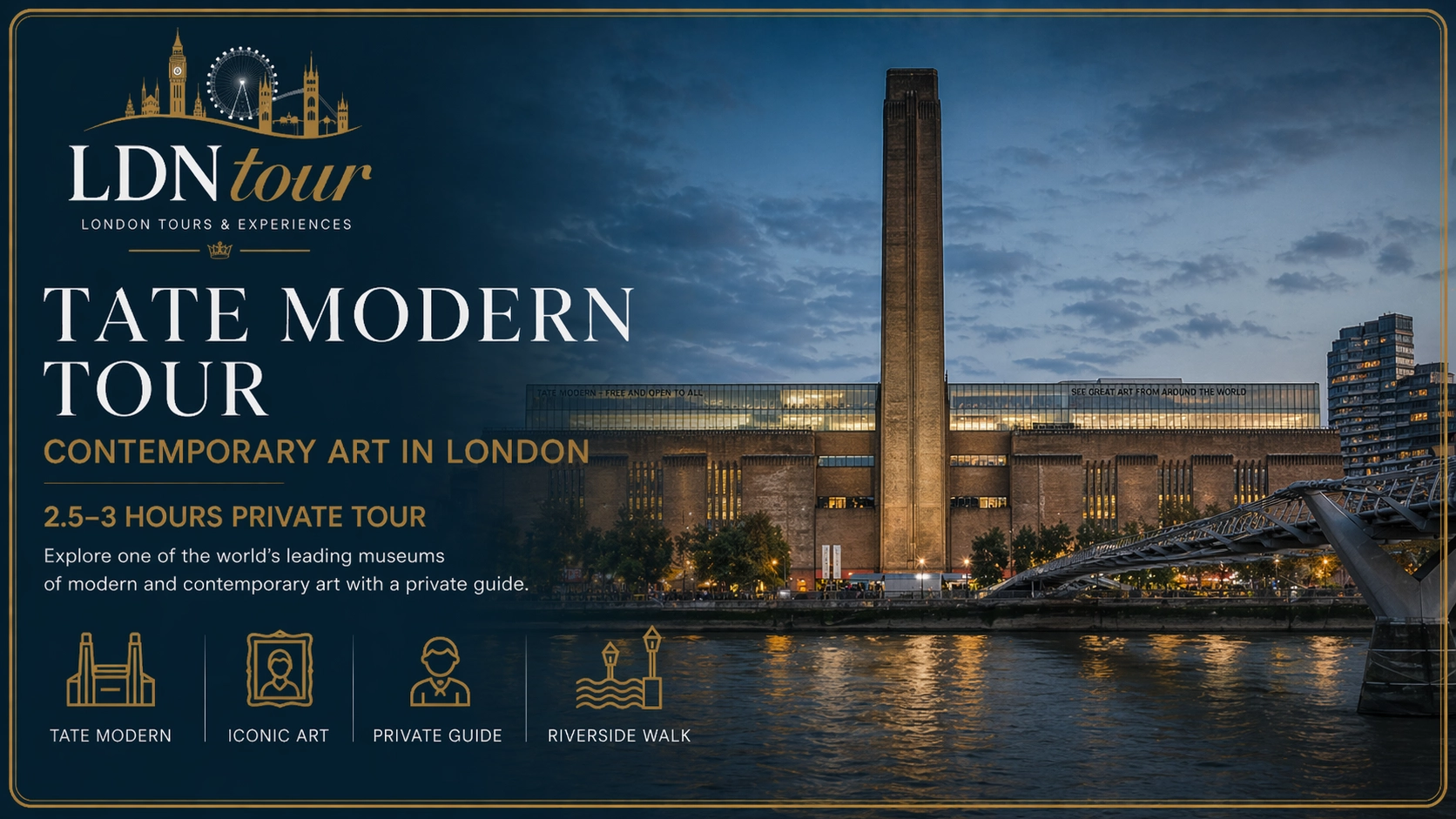
This is the first major museum in our programme on the south side of the Thames, in the former Bankside Power Station. Tate describes it as Britain’s national museum of modern and contemporary art, housed in the former power station and opened in 2000. The later extension, the Blavatnik Building, opened in 2016 and was designed, like the original conversion, by Herzog & de Meuron.
It is also one of the most successful museum transformations in the world. Tate’s own published material says Tate Modern has become the most popular modern and contemporary art attraction in the world, welcoming more than 5 million visitors a year.
This is not just another gallery. It is one of the defining museums of modern art anywhere.
Why Tate Modern matters
Tate Modern is different from the other museums on your site because it asks the visitor to look in a different way.
In Westminster Abbey, St Paul’s, the Tower of London and even the National Gallery, the visitor is usually dealing with objects that already come with fairly stable historical meanings. In Tate Modern, that is often not the case. Modern and contemporary art can be more open, more interpretive and more dependent on concept, context and the viewer’s own response.
That is exactly why the museum works both with a guide and without one.
Without a guide, Tate Modern can still be deeply enjoyable because it is such a strong visual space. You can walk through the building, take in the scale, react to the installations and paintings, and allow yourself to respond freely. With a guide, however, the museum becomes much richer, because the guide can begin to unlock the ideas behind the works, the movements behind the artists, and the reasons certain objects or installations matter. That is especially useful in a museum where interpretation is often part of the experience itself.
Why this museum feels more alive
Tate Modern has a different rhythm from many traditional museums.
Because it is a museum of modern and contemporary art, displays and temporary projects can feel more fluid and more changeable. The building itself supports that sense of reinvention. Tate’s venue material refers to spaces such as the Turbine Hall, The Tanks, Level 9, Level 10, and several Blavatnik Building concourses, which reflects just how varied the museum’s internal programming can be.
That makes it especially attractive to Londoners and repeat visitors, because it is one of those places you can return to and not feel you are seeing exactly the same museum every time.
Why book this tour with a guide?
Because modern art often benefits from interpretation more than people expect.
Sometimes contemporary works do come with a key. Sometimes they do not. Sometimes the artist wants a very specific reading; sometimes the work is deliberately open. A good guide helps you understand where interpretation is grounded and where it remains intentionally unstable.
That does not mean the guide tells you what to think. It means the guide gives you a stronger framework for looking.
This is one of the reasons Tate Modern can be quite demanding intellectually. In that sense it is one of the heavier museum experiences on the site — not heavier than the British Museum in terms of sheer civilisation-scale complexity, but still mentally substantial.
What makes Tate Modern different from Tate Britain?
This needs to be very clear.
Tate Modern and Tate Britain belong to the same wider Tate institution, but they are very different museums. Tate Britain focuses on British art. Tate Modern is the museum of modern and contemporary art. Tate’s own pages treat them as separate galleries with separate shops, separate buildings and separate visitor experiences.
So this page is specifically about Tate Modern, not British art in general.
What you will see
The exact route depends on the guide, what is on display that day, and how much emphasis you want on permanent collection material versus the broader architecture and current hang.
A strong Tate Modern tour may include:
- the overall story of the former Bankside Power Station and its transformation into a museum
- the Turbine Hall
- the main collection displays
- selected major modern and contemporary artists
- the Blavatnik Building
- the broader South Bank / river setting
- views towards St Paul’s Cathedral
- and, if relevant, the logic of temporary exhibitions and changing installations
Tate’s own material around Tate Modern repeatedly foregrounds the importance of the building itself, its former life as a power station, and the significance of the 2016 Blavatnik Building extension.
Artists and collection highlights
The exact works on display can change, and that matters more here than in some other museums.
But Tate Modern is strongly associated with major figures of modern and contemporary art, and visitors often hope to encounter artists such as Salvador Dalí and Andy Warhol, among many others. Tate’s public-facing material also emphasises the global modern and contemporary collection rather than only one national school.

As with the National Portrait Gallery, it is important to add a practical note: specific works can be rotated, loaned, moved or rehung, especially in a museum whose displays evolve actively. So any named work should be treated as an example of the kind of material you may see, not as a guaranteed promise for a specific date.
The building itself
The building is part of the attraction.
Tate Modern opened in the shell of the former Bankside Power Station, and Tate’s own publication on the museum describes Herzog & de Meuron as having worked with that industrial shell to create “a gallery of singular power and beauty”.
That is exactly the right phrase for the experience. The museum does not hide the power station origin; it uses it. The great vertical spaces, the famous chimney, the Turbine Hall and the newer angular geometry of the Blavatnik Building all contribute to the atmosphere.
The public does not go into the chimney itself as some kind of visitor space. It remains an external defining feature of the building rather than something visited as part of the standard tour. This is an inference from the available visitor/event materials, which describe public museum spaces elsewhere in the building, not inside the chimney.
Views and the South Bank setting
One of the pleasures of Tate Modern is that it connects beautifully to London outside the gallery too.
It sits on the South Bank, opposite St Paul’s Cathedral, with the Millennium Bridge nearby. That means the museum is one of the best places in London to combine art with strong urban views and a river setting. Tate’s Tate Modern shop pages explicitly refer to the “river side of the gallery” and to products connected with the local South Bank area.
This is one reason the museum can sometimes be extended, on request, with a short riverside or bridge-based continuation after the main visit.
Duration
The usual duration is around two and a half to three hours.
That gives enough time to understand the building, the main artistic logic and the key displays without making the visit too mentally heavy.
Start times
Tate’s public shop page for Tate Britain lists 10.00–18.00 daily, and the Tate institution uses the same visitor-facing framework across its London museums; however, because I do not have a directly retrieved Tate Modern visitor page in the search results here, I want to keep this practical rather than over-precise. The standard touring structure we are using for Tate Modern remains:
- 10:00 am — morning slot
- 2:00 pm
- 2:30 pm
- 3:00 pm — afternoon slots
These timings are sensible for a major London museum tour and fit the working assumptions you are using across the site. The existence of evening and event spaces at Tate Modern also supports the museum’s broader opening rhythm, though for standard touring the above slots are the most practical.
Meeting point
The standard meeting point is outside the main entrance to Tate Modern on the river side / Thames side, and we send the exact pin after booking.
This is the clearest place for guests, and it also allows the guide to begin with the building and river setting before entering.
Entry and exhibitions
The main collection is free, but major exhibitions are often ticketed separately. Tate’s membership materials explicitly promote free exhibition entry as a membership benefit, which confirms that exhibitions are a distinct category from the general free-access collection.
If there is a paid exhibition during your dates, we can discuss whether to include it in the day. In many cases, the strongest structure is:
- guided visit through the main collection first
- then self-guided entry to the exhibition afterwards
That keeps the visit balanced and avoids overloading the guide-led part of the day.
Group size
For practical guiding quality, we recommend:
- up to 20 people: one guide
- above 20 people: split into multiple groups
This is especially important in a museum where space can be visually dramatic but also noisy and busy.
Tour Guide Systems
For groups of six or more, we recommend our Tour Guide Systems.

Tate Modern can be loud, especially around the larger public spaces, and if the group is larger, audio systems make the experience significantly smoother.
We supply our own systems and can add them to your invoice.
Accessibility
Tate as an institution has extensive public access infrastructure, and Tate Modern is widely used for major public and event access. The Blavatnik Building and multiple concourse/event levels also strongly imply a high-access modern museum environment.
Tate Modern is generally suitable for wheelchair users and visitors with access needs. If anyone in your group has specific accessibility requirements, tell us in advance and we will plan the visit accordingly.
Families and children
Tate Modern can work very well for families, but it depends on the child.
For some children, the scale, objects and unexpected forms make it more engaging than a traditional old-master gallery. For others, modern art without the right framing can feel abstract or confusing. That is precisely where a good guide can help.
It can be educational, but it is not automatically the right first museum for every child.
Can this tour be combined with something else?
Yes, sometimes.
On request, if your visit is closer to two and a half hours, we may be able to add a short continuation:
- along the South Bank
- toward the Millennium Bridge
- or toward views of St Paul’s Cathedral
We discuss that case by case.
Booking process
This tour should be arranged in advance.
That is because:
- displays change
- exhibitions may need separate discussion
- the best guides for modern and contemporary art are fewer than for more general museum touring
- and larger groups may need Tour Guide Systems or multiple guides
Once you send the enquiry, we confirm the date, start time and guide availability, then issue the invoice.
Final thought
Tate Modern is one of the few museums in London that genuinely rewards both instinct and explanation.
You can walk in and respond to it visually. But if you want to understand why it matters — and why certain works and spaces have the impact they do — a guided visit opens far more of the museum.
If you want London’s most powerful museum of modern and contemporary art explained properly, this is where to do it.
Complete the enquiry form below to request your private Tate Modern Tour.
FAQ
Is Tate Modern the biggest modern art museum in the world?
Tate’s own published material says Tate Modern is the most popular modern and contemporary art attraction in the world. I am being careful not to state “biggest in the world” as a hard architectural fact here without a directly sourced Tate claim using exactly that wording.
Is Tate Modern on the south side of the Thames?
Yes. It is on the South Bank, opposite St Paul’s Cathedral.
Was Tate Modern built in a former power station?
Yes. It was created in the shell of the former Bankside Power Station.
What is the Blavatnik Building?
It is the major extension to Tate Modern that opened in 2016, designed by Herzog & de Meuron.
Can visitors go into the chimney?
No standard visitor route goes into the chimney itself. The chimney is a defining architectural feature, not a normal public visit space. This is based on the public-facing descriptions of accessible visitor/event spaces in the building.
Is entry free?
The main collection is free, but major exhibitions are often separately ticketed.
Can we combine Tate Modern with a short walk?
Sometimes yes, on request, especially with a short South Bank or Millennium Bridge continuation.
Is Tate Modern the same as Tate Britain?
No. Tate Britain focuses on British art; Tate Modern focuses on modern and contemporary art.
Is it good without a guide?
Yes — visually, absolutely. But it becomes much richer with a guide because interpretation matters strongly in modern and contemporary art.
Do you recommend Tour Guide Systems?
Yes, especially for groups of six or more.
Should larger groups be split?
We usually recommend splitting groups above 20 people.
Can children go to Tate Modern?
Yes, but suitability depends on the child’s age and interests. Some children respond very well to the scale and visual drama; others need more framing.