Table of Contents
If Westminster is the royal, political and ceremonial heart of London, then the City of London is its ancient core and commercial powerhouse.
This is the walking tour we normally recommend as the second step after Westminster — unless, of course, you have already taken our panoramic London tour by car, which covers both districts in one broader overview. On foot, however, the City deserves its own dedicated visit.
This is a private exterior walking tour lasting up to four hours. We do not go inside attractions on this standard route. Instead, we explore the Square Mile properly: Roman origins, medieval fragments, great churches, finance, insurance, markets, bridges, skyline and the dramatic contrast between old London and modern London standing side by side. The City of London is a distinct area — the famous Square Mile — with its own identity, governance and history, and it remains both the ancient centre from which London developed and one of the world’s major business districts.
Why take this tour after Westminster
That is the best order for most visitors.
Westminster shows you royal London, parliamentary London, parks, ceremony, palaces and the grand West End. The City then gives you a completely different side of the capital: older in origin, more compact in plan, more vertical in skyline, more commercial in energy, and more sharply layered between Roman remains, medieval streets, Wren churches and modern towers.
The contrast is one of the most interesting things about London. The City is where Londinium was established around AD 43–50, and today the Square Mile has only about 8,600 residents but hundreds of thousands of workers, which is one reason it often feels much quieter at weekends than on weekdays.
A different London
This walk feels very different from Westminster.
The streets are narrower in places, the historic layers are older, the skyline is sharper, and the atmosphere shifts quickly between churches, courtyards, trading history, finance, insurance, river views and some of the most recognisable modern buildings in London.
This is also the part of London that many visitors do not understand properly unless they walk it with a guide. People often hear “the City” and assume it means central London in general. It does not. The City of London is its own historic district, separate from Westminster.
What you can expect to see
The precise route depends on your guide, your pace, road crossings, weather, temporary closures and the exact point at which the walk begins, but a standard City of London walk may include many of the following:
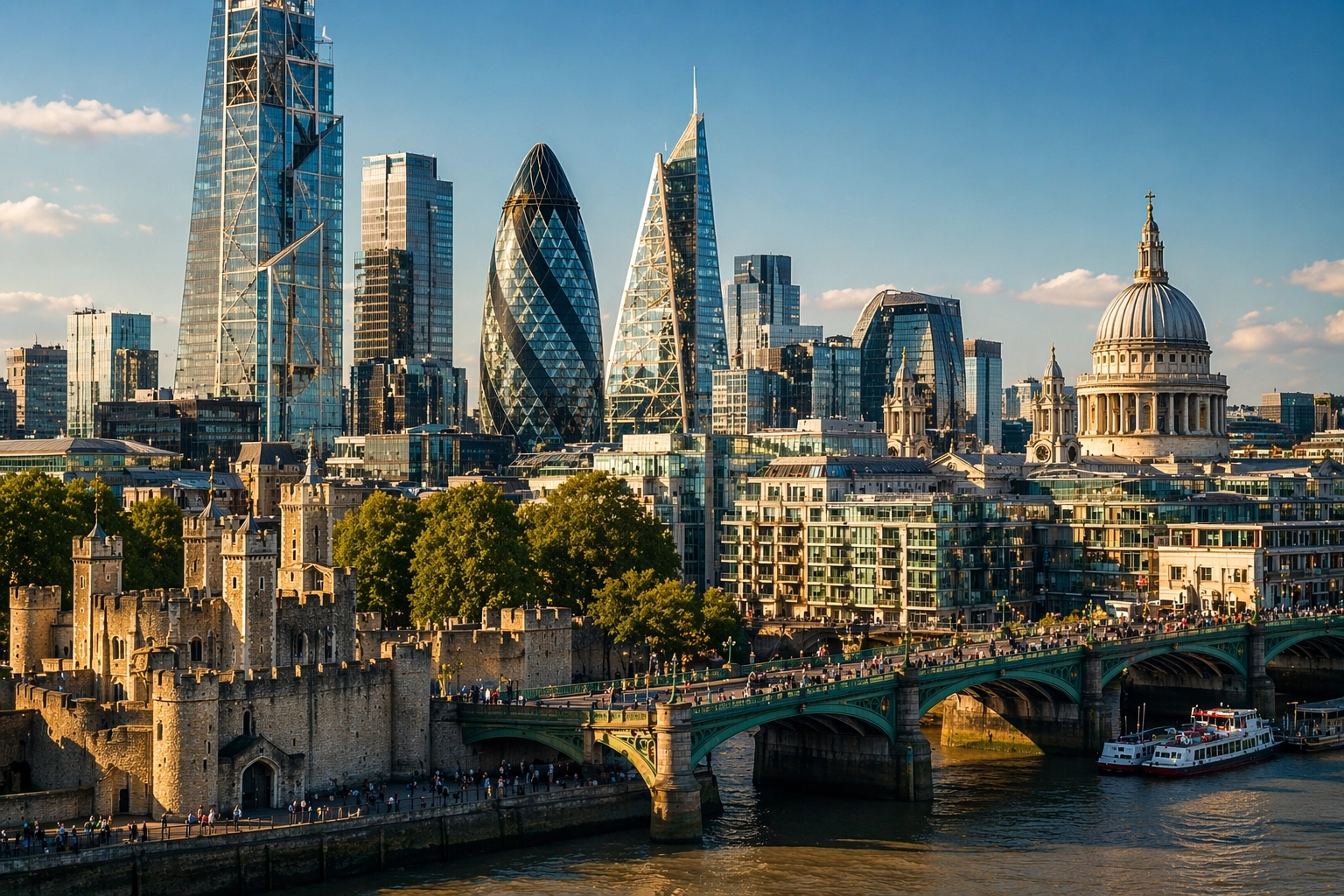
Tower of London, Tower Bridge, St Paul’s Cathedral, Leadenhall Market, the Lloyd’s Building, 30 St Mary Axe (the Gherkin), the Bank of England area, the Royal Exchange, Millennium Bridge, Tate Modern across the river, The Shard in the wider London Bridge skyline, and views toward HMS Belfast on the Thames.
That combination is what makes this route so strong: fortress, bridge, dome, market, finance, skyline and river, all in one coherent story.
Highlights of the route
Tower of London
For most visitors, this is the emotional anchor of the City walk. Even from the outside, the Tower gives the district its historic gravity. It is the point where royal power, defence, imprisonment and the London riverside all seem to meet.
Tower Bridge
Tower Bridge is not just photogenic. It is also an engineering story. Officially, it is both a bascule and suspension bridge, one of London’s best-known landmarks and one of the clearest visual transitions between historic and modern London.
St Paul’s Cathedral
St Paul’s is one of the defining buildings of London. It was designed by Sir Christopher Wren in the late seventeenth century, after the destruction of the old cathedral in the Great Fire, and it has served as the cathedral church of the Diocese of London for more than 1,400 years.
Leadenhall Market
This is one of the City’s great atmospheric stops. Leadenhall Market dates back to 1321, stands on what was the centre of Roman Londinium, and the present Victorian market building dates from 1881.
Lloyd’s Building
The Lloyd’s Building is one of the classic high-tech buildings of London. Opened in 1986 and designed by Richard Rogers, it is famous for placing its services — lifts, staircases, pipes and ducts — on the outside.
Bank of England and the Bank area
This is where the City’s institutional identity becomes clearest. The Bank of England is the UK’s central bank, founded in 1694, and its museum is in the City on Bartholomew Lane off Threadneedle Street.
The Royal Exchange
The Royal Exchange was formally opened by Queen Elizabeth I in 1571 and remains one of the great historic commercial buildings of the City.
Millennium Bridge
The Millennium Bridge opened in 2000 and was the first new pedestrian bridge over the Thames for more than a century. It links St Paul’s Cathedral to Tate Modern, which is why this stretch of the walk feels so visually satisfying.
Tate Modern, The Shard and HMS Belfast
From the City side of the river, you also get some of the strongest long views in London. Tate Modern is internationally known as a major museum of modern and contemporary art; The Shard is 309.6 metres high and describes itself as Western Europe’s tallest building; and HMS Belfast remains moored on the Thames as part of Imperial War Museums.
Duration
The standard tour lasts up to four hours.
That is long enough to give the City proper shape and meaning without turning the walk into a forced march. As with our Westminster walk, the pace depends on you. Some guests want a brisk, visually rich route with strong orientation. Others want more pauses, more discussion, more photographs and more time to take in details.
Because this is a private tour, the rhythm can be adjusted.
Start times
Morning slot
If you are taking the tour in the morning, the latest sensible start is 9:30 am.
Afternoon slot
From 2:00 pm onwards, the timing is more flexible, and afternoon or early evening City walks can work especially well because the light on the stone, glass and river is often very good.
As with Westminster, guide schedules are usually structured in two halves. If you want an awkward in-between start that blocks the whole day, pricing may need to reflect that.
Where this tour usually starts
The City of London sits a little away from the areas where many visitors stay, especially Mayfair and Belgravia.
That matters practically.
If you are coming on your own to the meeting point, then you should be there by the agreed start time — no later than 9:30 am for a morning booking, or at the chosen hour for an afternoon booking.
Because different City routes can sensibly begin from different points, we normally confirm the exact meeting point after booking. Very often it will be near Tower Hill or another convenient City location depending on the route and your plans for the rest of the day.
This is an exterior walking tour
Just as with the Westminster version, all major sites on this standard route are seen from the outside.
That is deliberate.
The purpose of the tour is to help you understand the structure, atmosphere and visual language of the City first. If you then want to go deeper into interiors — for example the Tower of London, St Paul’s, or another specific site — that works best as a separate visit or as part of a different tailored day.
Safety and practical advice
Please wear:
- comfortable shoes;
- weather-appropriate clothing;
- something waterproof if rain is likely;
- an umbrella or raincoat when needed.
London weather changes quickly, and ordinary rain does not cancel the tour.
Please also remember:
- traffic in the UK moves on the left;
- you remain responsible for your own safety when crossing roads;
- you should supervise your children and your group at all times;
- you should watch your footing, especially on older pavements, uneven stone and busier streets.
Even if the guide is leading confidently, you should still cross carefully and use pedestrian signals wherever possible.
Group size
A walking tour is naturally easier on the budget than a chauffeured tour because there is no vehicle cost attached.
For small private groups, that makes it especially efficient. For larger parties, we can provide our own Tour Guide Systems, so everybody can hear clearly without crowding around the guide.
That means the tour can work very well for:
- couples;
- families;
- friendship groups;
- educational groups;
- corporate groups;
- and much larger parties.
Why this tour is worth doing
Because this is where London’s timeline becomes visible.
In Westminster, London often feels ceremonial and grand. In the City, it feels layered, compressed, old and modern at once. Roman foundations, medieval traces, great churches, insurance, finance, glass towers, markets and river crossings all sit inside one small district.
If Westminster explains London’s public face, the City explains its origins and its engine.
That is why this walk makes such a strong companion to the Westminster tour.
Booking
Booking is simple.
Complete the enquiry form at the bottom of the page and send us your details. You will receive an automatic confirmation email. If you do not see it, please check your junk or spam folder. Replying briefly to that email often helps later messages reach your main inbox.
We then confirm the outline with you, issue the invoice, and secure the guide once payment is received.
As with our other private tours, this is arranged specifically for your party, so late cancellations or date changes are often limited once services have been secured. Please see our Terms and Conditions for the full position.
Final thought
This is not the London of palaces and ceremonial parks.
This is the London of origins, trade, resilience, bridges, domes, markets, institutions and skyline.
Take Westminster first if you like. Then come here. The contrast is one of the best things about the city.
Complete the enquiry form below to request your City of London Walking Tour.
FAQ
Is this the right tour to take after Westminster?
Yes. For most visitors, that is exactly the right order. Westminster first, then the City.
Is the City of London the same as Westminster?
No. They are separate historic districts. The City of London is the Square Mile, distinct from Westminster.
Why does the City feel quieter at weekends?
Because relatively few people live there compared with the enormous weekday working population.
Do we go inside the Tower of London or St Paul’s Cathedral?
No. This standard route is an exterior walking tour.
How long does the tour last?
Up to four hours.
What is the City of London most famous for?
Its Roman origins, the Square Mile identity, financial and insurance institutions, St Paul’s Cathedral, Tower Bridge, the Tower of London, historic markets and the modern skyline.
Was Roman London founded here?
Yes. Londinium was established on the current site of the City of London around AD 43–50.
Is this tour suitable for first-time visitors?
Yes, especially if you already understand Westminster or have seen it by car.
Where does the tour usually start?
Usually somewhere practical in the City, often near Tower Hill or another agreed point depending on the route.
Does rain cancel the tour?
No. Ordinary rain does not cancel the tour.
What should we wear?
Comfortable walking shoes and weather-appropriate clothing, ideally including a waterproof layer.
Will we see Tower Bridge?
Usually yes. It is one of the defining highlights of the route.
Will we see St Paul’s Cathedral?
Usually yes. It is one of the major anchors of the walk.
Can large groups do this tour?
Yes. We can provide Tour Guide Systems for larger groups.
Is Leadenhall Market normally included?
Often yes, depending on the exact route and starting point. It is one of the most atmospheric parts of the City.
Can the tour end near Tate Modern or London Bridge?
Sometimes yes, depending on the route and your plans for the rest of the day.
Is the Shard in the City of London?
No. It is across the river in the London Bridge area, but it is often part of the skyline and river views from this walk.