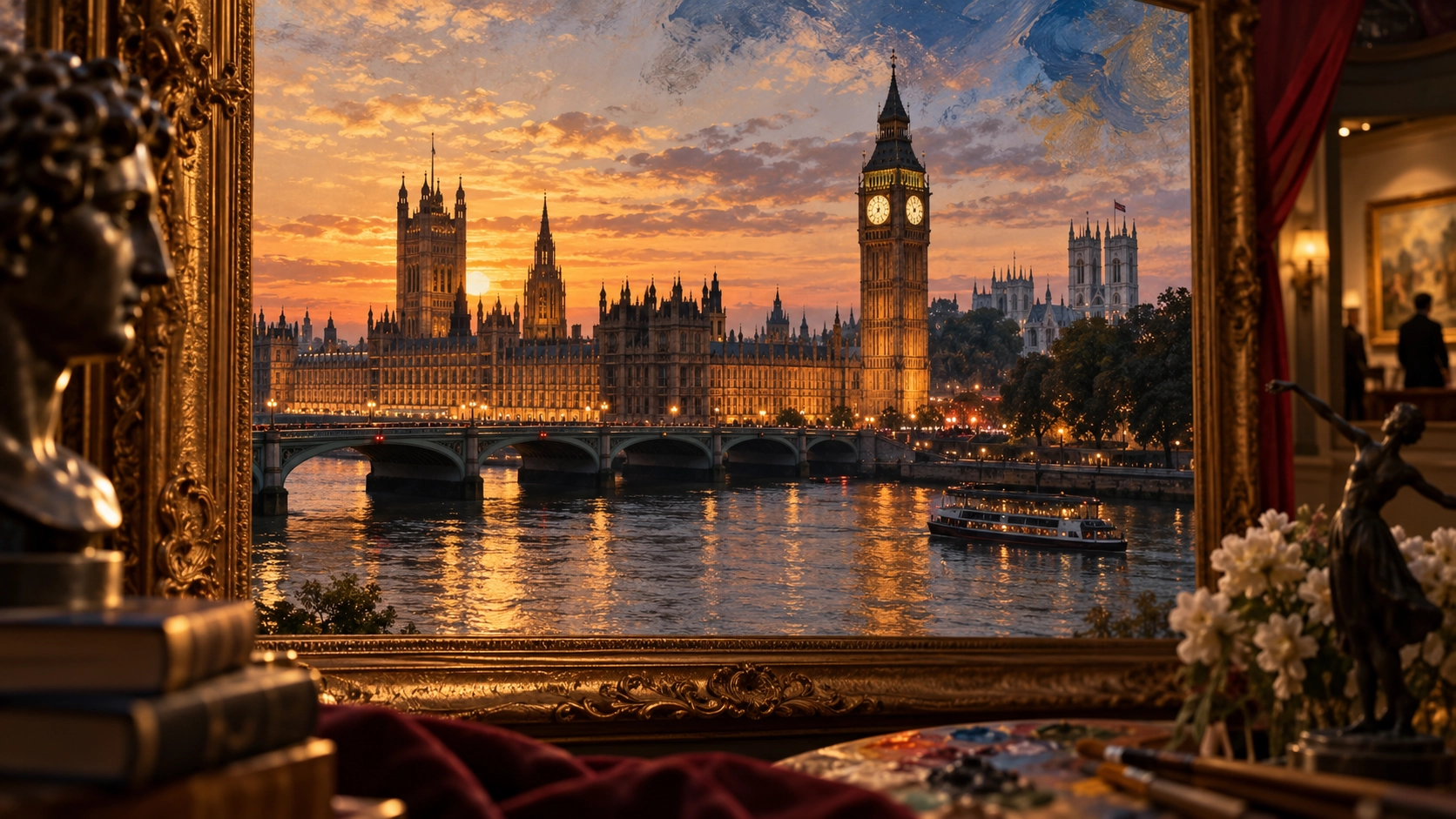
What if the most memorable London experience is the one you would never have chosen for yourself?
In recent years, my partner and I have become increasingly interested in temporary exhibitions, cinema, theatre and other cultural experiences in London.
At first, I thought we simply wanted something new:
- new emotions;
- new sensations;
- new ideas;
- something different to do at the weekend.
But gradually I realised that something more interesting was happening.
A good film or exhibition does not necessarily give you an answer. Very often, it leaves a space in which you begin asking your own questions:
- Why did this character behave like that?
- Why does this painting make me uncomfortable?
- Why am I attracted to something I know is dangerous?
- Why did people living 500 years ago worry about exactly the same things we worry about today?
And suddenly you are no longer discussing a film or a painting.
You are discussing:
- relationships;
- fear;
- love;
- power;
- family;
- mortality;
- identity;
- beauty;
- prejudice;
- ambition;
- and sometimes even your own life.
That, for me, is where culture becomes much more than entertainment.
It becomes a way of seeing.
Culture gives us something to talk about
I have noticed something else.
When we meet friends after seeing a particularly interesting exhibition or film, we suddenly have extraordinary subjects for conversation.
Not politics.
Not war.
Not somebody’s health.
Not gossip.
We can disagree completely about what a director meant or what a painting represents, and the disagreement itself can be enjoyable.
Contemporary art and modern cinema are particularly good at creating this space because interpretation is often intentionally left open.
Sometimes the conversation after the film is almost as valuable as the film itself.
And this led me to another thought:
What if London itself can be experienced in exactly the same way?
London is not simply a city. It is a work of art.
Think about The Ambassadors by Hans Holbein the Younger in the National Gallery.
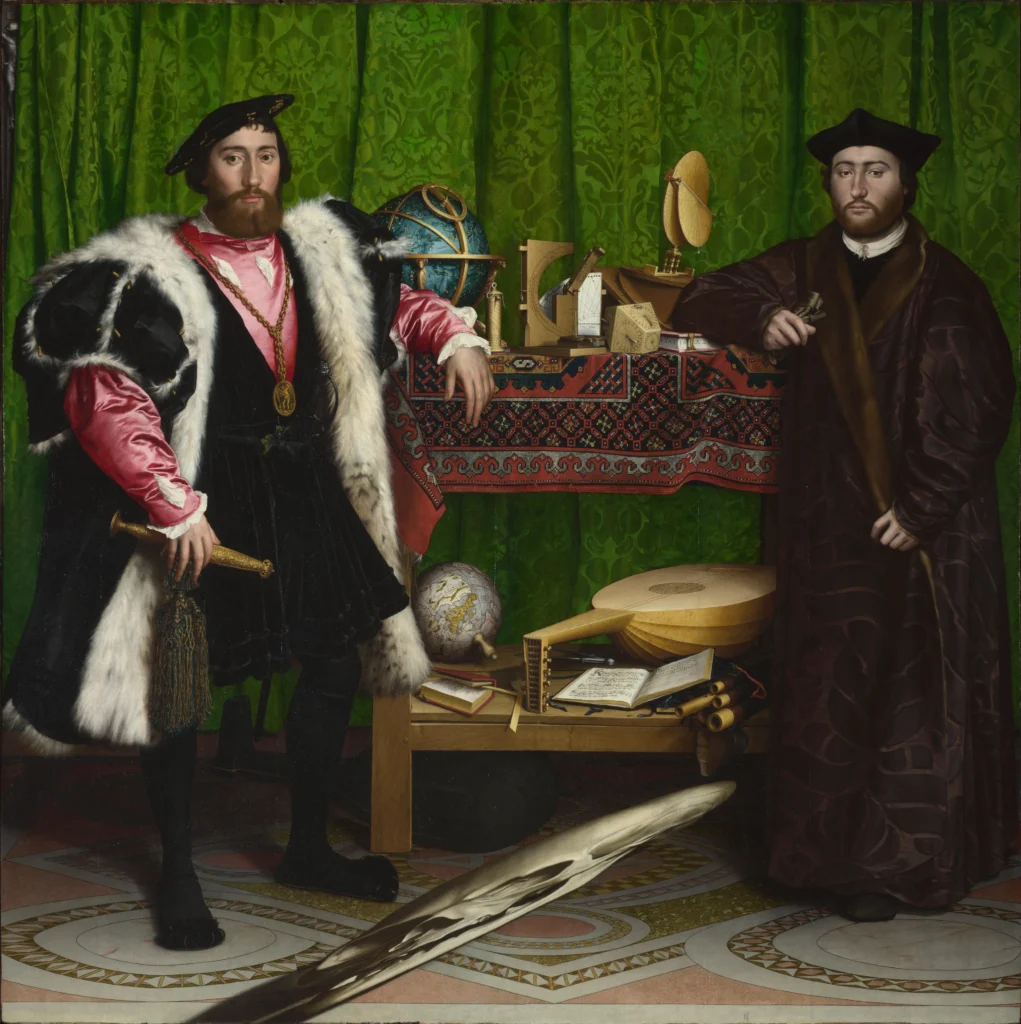
Seen directly, it is a magnificent Renaissance painting of two educated, powerful men surrounded by objects representing:
- knowledge;
- music;
- science;
- wealth;
- status.
But there is something strange across the bottom of the painting.
The elongated shape looks almost meaningless when viewed straight on. To reveal Holbein’s trick, you have to change your position completely.
If you are viewing the painting on your phone, try this: tilt the phone so that you are looking across the screen from the bottom-right corner, almost along the surface of the display rather than directly at it. Turning the phone slightly clockwise may make the position easier to find, but the important part is the very sharp viewing angle.
From the correct position, the strange stretched shape suddenly resolves into a human skull.
This is anamorphosis — an image deliberately distorted so that it becomes recognisable only from a particular viewpoint.
And that is precisely what makes The Ambassadors such a perfect metaphor for London.
The painting did not change.
You changed the angle from which you looked at it.
I think London works in exactly the same way.
You can stand in front of Big Ben and see Big Ben.
You can visit Westminster Abbey and learn:
- when it was built;
- who was crowned there;
- who is buried there;
- what historical events took place there.
You can see Buckingham Palace, the Tower of London and the National Gallery.
All of that is important. These are some of the greatest landmarks in the world.
But change the angle slightly and another London begins to appear.
- Westminster Abbey becomes a conversation about how nations construct memory.
- The Tower of London becomes a story not merely about medieval kings and prisoners, but about power, fear, ceremony, continuity and the way institutions survive by constantly changing their purpose.
- Buckingham Palace becomes not simply a royal residence but a fascinating example of ritual, symbolism and the public performance of monarchy in a modern democracy.
- A painting becomes something more than a beautiful object.
- A city becomes something more than sightseeing.
The problem with the perfect London itinerary
Many of our clients at LDN Tour are experienced and affluent travellers.
A classic London programme may include:
- a private sightseeing tour;
- Westminster Abbey;
- the Tower of London;
- the National Gallery;
- The Phantom of the Opera;
- Wimbledon;
- Royal Ascot;
- a major football match;
- a chauffeured Mercedes;
- some of London’s finest restaurants.
There is absolutely nothing wrong with this.
In fact, these are wonderful experiences.
But there is an interesting limitation built into almost every luxury travel itinerary.
The person arranging the journey — whether a:
- personal assistant;
- concierge;
- travel adviser;
- secretary;
- family office representative —
has a responsibility to make sure everything works.
Naturally, that encourages safe choices.
Nobody needs to explain why they booked Wimbledon.
Nobody will question Westminster Abbey.
Claridge’s does not require an introduction.
A Michelin-starred restaurant is an understandable recommendation.
But recommending something less predictable carries more risk:
- an experimental dance performance;
- an unfamiliar temporary exhibition;
- a film preview followed by a discussion with its director;
- a public lecture on cosmology;
- an unusual theatrical production.
The client may love it.
Or the client may say:
“Why did you send me there?”
So the itinerary naturally gravitates towards the recognisable.
The result can be an exceptionally expensive, beautifully organised trip in which almost everything is something the traveller already knew existed before arriving.
That is precisely where I believe a different kind of travel curation becomes valuable.
A tour can give you information. An experience can change the way you remember a place.
I have spent many hours accompanying tours in London and listening to professional guides.
There are extraordinary guides in this city — people with:
- decades of knowledge;
- wonderful voices;
- humour;
- charisma;
- an astonishing command of British history.
The issue is not the quality of the guide.
It is the expectation built into the traditional sightseeing format.
When you approach a landmark, there is information a visitor reasonably expects to receive:
- What is it?
- When was it built?
- Who designed it?
- What happened here?
- Why is it important?
Then we proceed to the next landmark.
This framework works. It is one reason professional guiding exists.
But I increasingly believe that there is room for another layer.
Instead of only asking:
“What happened here?”
we can also ask:
“Why does this matter to us now?”
That small change can completely transform an experience.
Dates can be forgotten. An idea is much harder to forget.
I know this because I once went to the same musical around 150 times
Many years ago, when The Bodyguard was playing in London, I became completely obsessed with it.
I am almost embarrassed to admit how many times I went.
Probably around 150 times.
At the time I was working as a guide, and I regularly persuaded my clients to see it.
I should confess that there may have been a slightly selfish motivation: if they went, I could go again too.
And every time, something happened to me:
- goosebumps;
- tears;
- that extraordinary physical sensation when music, performance and emotion suddenly come together.
I also saw Billy Elliot an extraordinary number of times — probably around 50.
Those productions eventually disappeared.
And I discovered something surprising.
Finding a genuinely new emotional experience was not as easy as I expected.
When luxury itself becomes familiar
Over years of working with clients, I had also seen another side of London:
- Rolls-Royces;
- chauffeured Mercedes;
- Harrods;
- extraordinary hotels;
- Michelin-starred restaurants;
- private dining;
- some of the most expensive places in Britain.
It was never really my lifestyle — I experienced much of it through my work.
But eventually even luxury became familiar.
And familiarity changes everything.
The challenge was no longer gaining access.
The challenge became:
Where do I find surprise?
We found it again in exhibitions and cinema
Over the past few years, exhibitions and cinema have opened another door for us.
And London is an extraordinary city in which to make that discovery.
A major cultural experience may exist for only a short period of time.
For example:
- a rare group of paintings may be assembled in one room and never be shown together again in our lifetime;
- a film can be screened before its general release;
- a screening can be followed by a conversation with its director or actors;
- a free lecture can introduce you to a field you have never studied;
- a contemporary dance performance can communicate something about relationships without saying a single word.
These experiences are temporary.
That is part of their value.
In 2026 alone, London has moved from major exhibitions such as Zurbarán at the National Gallery and James McNeill Whistler at Tate Britain to the extraordinary arrival of the Bayeux Tapestry at the British Museum, while the National Gallery prepares to bring together Jan van Eyck’s known painted portraits in an unprecedented exhibition.
The city keeps changing.
That means the best London itinerary should change with it.
A programme designed six months ago may completely miss what makes London extraordinary this week.
Sometimes a £15 cinema ticket can be a greater luxury than a £500 dinner
Recently we attended a preview of the Australian horror film Leviticus at the Barbican.
What fascinated us was not simply the horror story.
The film creates a monster that takes the appearance of the person its victim most desires.
That produces an uncomfortable contradiction:
- attraction and fear;
- desire and danger;
- wanting to move closer and wanting to escape.
After the screening, director Adrian Chiarella and actor Joe Bird came onto the stage for a ScreenTalk with the audience.
Think about what that means.
You can:
- sit in one of the world’s great cultural cities;
- watch a new film;
- encounter an idea you had never considered before;
- listen to the people who created it discussing their decisions;
- potentially ask them a question yourself.
This does not require a private jet.
It does not require membership of an exclusive club.
Sometimes the ticket costs less than a main course in a London restaurant.
Yet the experience may stay with you much longer.
Luxury and value are not always the same thing.
The masterpieces everybody walks past
The National Gallery provides another perfect example.
Stand inside long enough and simply watch how people move.
Visitors can walk past:
- Leonardo da Vinci;
- Michelangelo;
- Raphael;
- Titian;
- Botticelli.
Sometimes without stopping at all.
I do not say this critically.
A museum is overwhelming.
There are hundreds of objects competing for attention. We naturally recognise the names and images we have already been taught to recognise.
But imagine somebody stopping you and saying:
“Look at this one. Before we move on, let me tell you why this changed the history of art.”
Suddenly you look differently.
That is what curation does.
It does not necessarily show you something that was hidden.
Sometimes it simply helps you notice something that was directly in front of you.
London is full of experiences you may never think to request
A London journey can include far more than landmarks, shopping and restaurants.
It can include:
- contemporary dance at Sadler’s Wells;
- performances at the Royal Ballet and Opera;
- experimental theatre;
- film previews and ScreenTalks;
- temporary museum exhibitions;
- lectures on science, art, law, astronomy, music and society;
- RHS Chelsea Flower Show;
- ABBA Voyage;
- architecture festivals;
- artists’ studios;
- auctions;
- historic houses;
- design events;
- public debates;
- institutions that open their doors only occasionally.
Some will be profound.
Some will simply be beautiful.
Some may confuse you.
And, importantly:
some may not be to your taste at all.
I think that is perfectly acceptable.
Allow yourself one experience you would never have chosen
This may be the most important advice I can give somebody planning a trip to London.
Do not abandon the things you already love.
- Stay at Claridge’s.
- Book the Mercedes.
- Go to Wimbledon.
- Enjoy the tasting menu.
- See The Phantom of the Opera.
There is no virtue in rejecting pleasure simply because it is popular or expensive.
But leave one space in your programme for something else.
Give your travel adviser permission to take a small risk.
Say:
“Give me one thing I would never have chosen for myself.”
Perhaps it will be:
- a dance performance;
- a Renaissance painting;
- an unknown film;
- an hour listening to an astrophysicist discussing the universe;
- a garden;
- a building;
- something you initially dislike.
But it may generate the conversation you remember long after you have forgotten what you ordered for dinner.
Our idea of a bespoke London experience
This is increasingly how we think about travel at LDN Tour.
We do not want to replace classic London.
We want to add another dimension to it.
A first-time visitor should absolutely see the icons.
But perhaps we can also:
- give you a short cultural briefing before your private London tour;
- explain not simply what you are going to see, but how some of it connects with contemporary life;
- understand what currently interests you and select an exhibition, film, performance or place that connects with it;
- tell you what is happening in London during the exact week you are here;
- combine a traditional private guide with something unexpected;
- introduce one carefully chosen cultural “wildcard” into your itinerary.
Because the purpose is not simply to see more.
It is to notice more.
London on a silver platter
Sometimes I imagine London as a silver platter.
On it are:
- diamonds;
- rubies;
- sapphires;
- and stones whose names you may not even know.
The city holds them out to you.
And on that platter are:
- art;
- architecture;
- history;
- music;
- cinema;
- science;
- theatre;
- gardens;
- ideas;
- people;
- stories.
You can take what you already recognise.
Or somebody can point to the stone you were about to ignore and say:
“Look at this one.”
That, for me, is what a truly bespoke London experience should do.
London has given enormous depth to my own view of the world.
It has encouraged self-reflection and changed the way I think about:
- culture;
- relationships;
- history;
- beauty;
- ordinary life.
Perhaps that is why I increasingly want to share this side of the city with our clients.
Not because everyone needs to love contemporary art.
Not because every holiday must become an intellectual exercise.
And certainly not because there is anything wrong with enjoying beautiful hotels, restaurants, sport or shopping.
Simply because:
London contains more.
Much more.
And if you are willing to change the angle from which you look at it, the same city you thought you knew can suddenly become something completely different.
Just like Holbein’s painting.
The picture was there all along.
You simply had to know where to stand.
Experience London differently with LDN Tour
If you are looking for:
- a private London tour;
- a bespoke London itinerary;
- a luxury London programme;
- cultural experiences in London;
- or a journey built around more than the obvious attractions —
talk to us.
Tell us what you already know.
Tell us what you love.
Tell us what you have seen a hundred times.
And perhaps most importantly:
Give us permission to show you something you would never have thought to ask for.
LDN Tour
Not simply seeing London, but discovering how to look at it.