
Table of Contents
The Natural History Museum is, in our view, the number one museum for children in London — and arguably one of the strongest family museums in the whole of Britain.
People may argue that the Harry Potter Studio Tour is more exciting, and in pure popularity terms that is understandable. But the Natural History Museum belongs to a different category. It is a real museum in the fullest sense: science, discovery, education, architecture, collections and wonder, all under one roof. The museum itself says it first opened its doors on 18 April 1881, though its origins reach back to 1753 and the collection of Sir Hans Sloane. It also explains that the South Kensington building was created under the influence of Sir Richard Owen, and that architect Alfred Waterhouse gave it its distinctive Romanesque and Gothic Revival character.
That is one reason the museum already feels special before you even step inside.
Why this museum matters
This is not just a museum of dinosaurs.
It is a museum about the natural world, past and present: animals, birds, insects, rocks, minerals, fossils, meteorites, extinction, evolution and the history of life on Earth. The museum says its purpose is to create advocates for the planet and that its collections and galleries help visitors understand the natural world and humanity’s place within it.
That makes it one of the easiest London museums to enjoy visually — but also one of the most rewarding to do with a guide. A guide helps connect the dinosaurs to the history of scientific discovery, the meteorites to the formation of the solar system, the taxidermy and zoological displays to evolution and biodiversity, and the geology galleries to the story of the Earth itself.
Why go with a guide?
Because this museum is vast.
If you walk through it on your own, you can absolutely enjoy it. In that sense it is more immediately legible than the British Museum. The architecture is dramatic, the dinosaurs are obvious, the specimens are memorable and the giant blue whale skeleton in Hintze Hall makes an instant impression. But with a guide, the museum becomes much more than a sequence of impressive things. It becomes a story about life, extinction, survival, geology and the development of scientific knowledge.
That is especially useful for families, because a guide can shape the visit around the interests and age of the group rather than trying to cover everything.
What makes the building special
The building itself is one of the museum’s great exhibits.
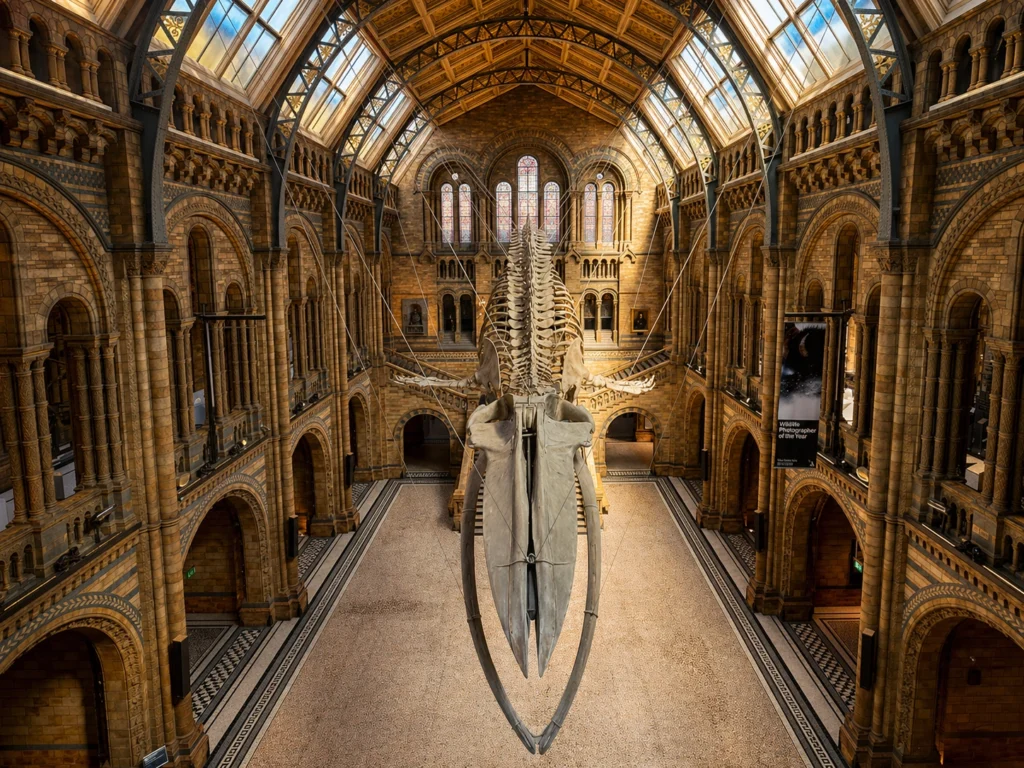
The Natural History Museum explains that Alfred Waterhouse designed it in line with Richard Owen’s vision of a “cathedral to nature”, and that the architectural decoration includes both living and extinct animals. The main central hall — now Hintze Hall — is one of the most famous museum interiors in London. Since 2017, the suspended blue whale skeleton there has been one of the defining sights of the museum.
So this is one of those rare museums where the building already begins the lesson before the galleries do.
What you will see
A strong Natural History Museum tour usually includes a carefully selected route through the most rewarding galleries, depending on the age and interests of your group.
That often includes:
- Hintze Hall
- the Dinosaurs Gallery
- selected fossil highlights
- the Earth Hall geology and mineral displays
- meteorites
- major zoological or biodiversity displays
- and, where relevant, galleries shaped around your specific interests
The exact route can be adjusted. If you especially want dinosaurs, meteorites, mammals, rocks and minerals, or extinct species, we can lean in that direction.
Dinosaurs
The dinosaurs are one of the museum’s biggest attractions.

The museum’s own dinosaur collection page says it houses one of the world’s most important dinosaur collections, with 157 taxa and 69 type specimens. The public Dinosaurs Gallery is one of the most visited parts of the museum, with highlights including the famous animatronic Tyrannosaurus rex, a Triceratops skull, and some of the most important dinosaur fossils in the world. The museum also notes that its collection includes material connected to Iguanodon and Hylaeosaurus, two of the three taxa used by Richard Owen when defining Dinosauria in 1842.
That is why this part of the museum works so well with children and also why it works well with a guide: there is real scientific depth behind the spectacle.
Archaeopteryx and early birds
The museum is also associated with one of the most historically important fossils in the world: Archaeopteryx.
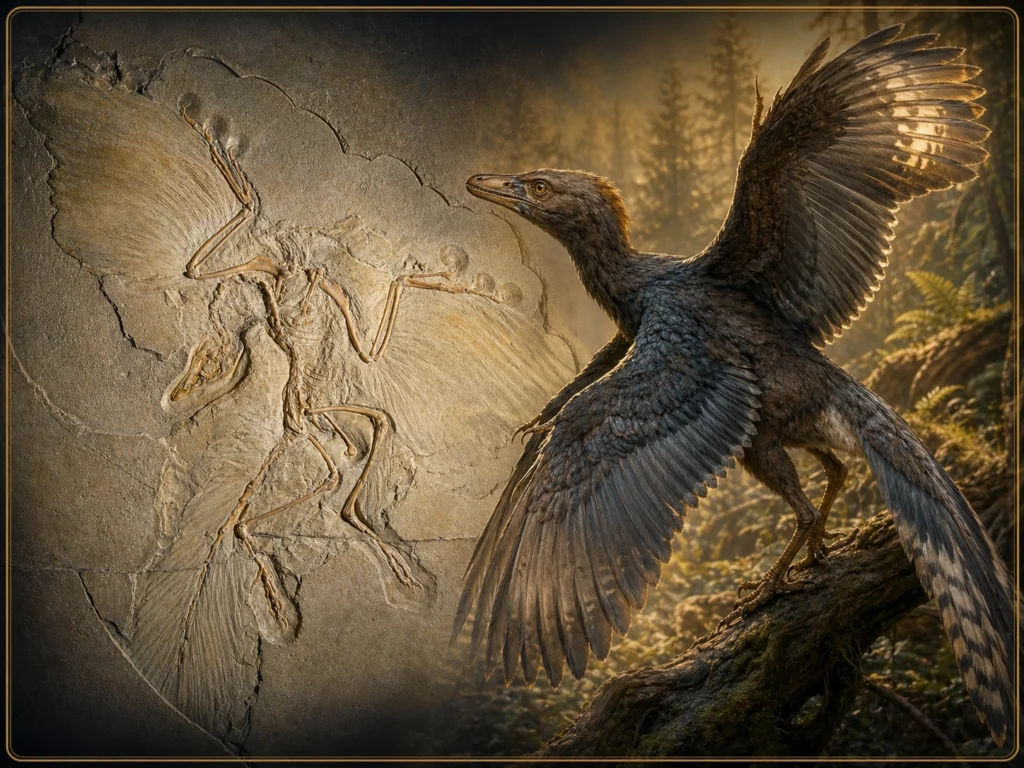
Rather than calling it “the first bird on Earth”, which would be too absolute, the safer and more accurate way to describe it is that Archaeopteryx is one of the most famous early bird fossils and one of the key transitional fossils in the history of life. The Natural History Museum’s own science and collections materials strongly frame its fossil collections as globally important in understanding evolutionary history.
Meteorites, Moon rock and Earth science
One of the museum’s most underrated strengths is its Earth science material.
The museum’s Earth Hall and Stegosaurus page says visitors can see gems and minerals including a piece of moon rock. The museum also has strong public geology and meteorite interpretation, and this is one of the best parts of the building for visitors interested in the Earth itself rather than only animals and dinosaurs.
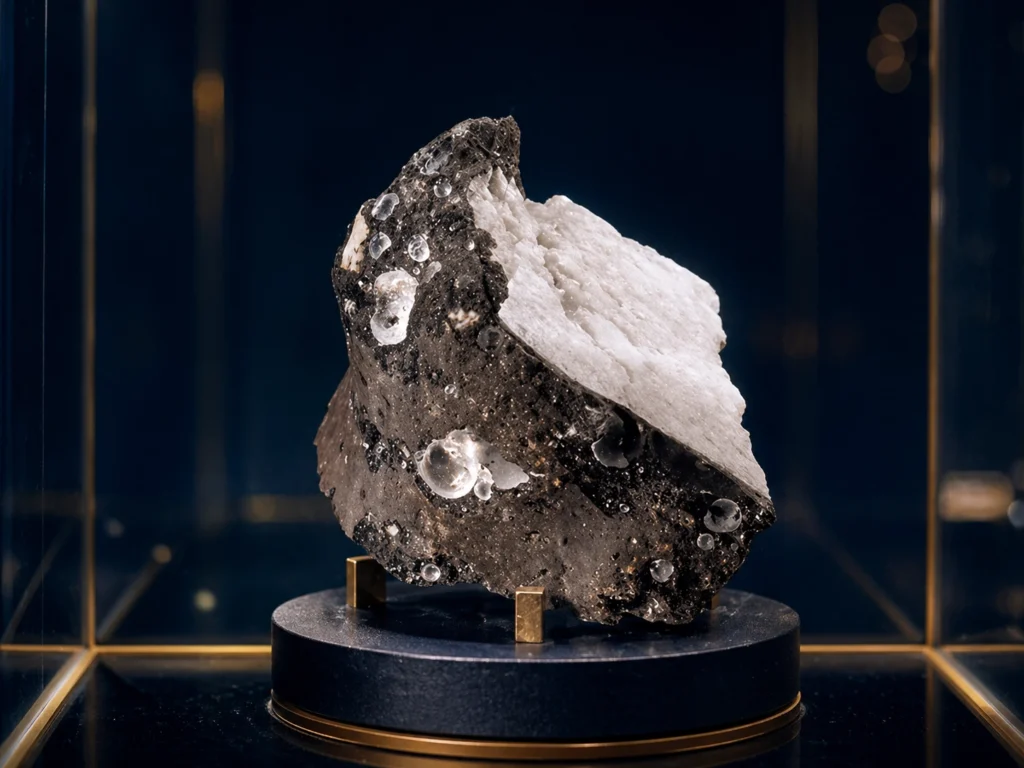
If your family is more interested in rocks, planets, meteorites and the physical story of the Earth, the museum can be shaped that way too.
Animals, birds and life on Earth
Another great strength of the museum is that it brings the natural world close.
That can mean taxidermy, skeletons, extinct species, major mammal displays, biodiversity galleries and the wider visual experience of seeing life arranged scientifically rather than sentimentally. This is often one of the reasons children remember the museum so vividly: the distance between them and the natural world suddenly feels much smaller. The museum’s own history and collections pages emphasise that it grew from one of the world’s great natural history collections and continues to house major scientific collections.
Duration
The standard tour lasts around two and a half to three hours.
That is the right balance for most families and for most adults. The museum is huge, and if you try to turn it into a marathon, the quality of attention drops. A focused route is much stronger.
Start times
The Natural History Museum states that the South Kensington site is open daily 10:00–17:50, with last entry at 17:30, and that entry is free, though booking is recommended for the best experience during busy periods.
Our standard guided tour timings are therefore:
- 10:00 am — morning slot
- 2:00 pm
- 2:30 pm
- 3:00 pm — afternoon slots
We strongly recommend the morning slot where possible.
Meeting point
You asked to use the corner of Exhibition Road and Cromwell Road, and that is correct in practical terms.
The museum’s own Getting here page says the Central Entrance is on the corner of Cromwell Road and Exhibition Road, and that it is step-free.
So our standard meeting point wording should be:
Meet your guide outside the Natural History Museum at the corner of Exhibition Road and Cromwell Road, by the Central Entrance.
The exact pin will be sent after booking.
Entry, queues and tickets
Entry to the museum is free, but the museum explicitly recommends booking a free ticket in advance for the best experience, especially during busy times. It also says it reserves some space for walk-up visitors, but you may wait longer to get in.
That makes advance planning worthwhile, especially in school holidays and peak visitor seasons.
Accessibility
The Natural History Museum states that it aims to provide a friendly, accessible environment and the widest possible access to its buildings, exhibitions and collections. Its Central Entrance is step-free, and its visitor pages place accessibility as a core part of planning your visit.
So this museum is a strong option for wheelchair users and visitors with access needs.
Facilities
The museum’s visitor pages say it offers places to eat, drink and shop, and describe roaming the galleries and gardens as “exhausting stuff”, which is accurate enough. The museum has cafés and shops, and it is set up for long public visits.
Group size
For practical guiding quality, we recommend:
- up to 20 people: one guide
- above 20 people: split into multiple groups
That keeps the visit manageable, especially in the busier dinosaur and family zones.
Tour Guide Systems
For groups of eight or more, we strongly recommend our Tour Guide Systems.

The museum can be noisy, and for school-age groups and larger family groups they make the experience much smoother.
We supply our own systems and can add them to your invoice.
Can this tour be customised?
Yes — very effectively.
This museum is particularly easy to shape around a theme. For example:
- dinosaurs
- fossils
- meteorites and geology
- extinct species
- mammals and birds
- or a more general family highlights route
That flexibility is one of its biggest advantages.
Can it be combined with another museum?
In theory, yes. In practice, we usually recommend against it.
Because the Natural History Museum sits next to the V&A and the Science Museum, clients are often tempted to combine them. That is understandable, but usually too much. Even one museum here can easily fill a good half day properly.
If you do want a combination, the most natural pairing is:
- Natural History Museum + Science Museum
But only in a reduced, surface-level format. For a proper guided visit, we strongly prefer one museum per day.
Booking process
This tour should be booked in advance.
That is because:
- free-entry booking is often worth arranging in advance
- the strongest museum guides are not always easy to secure
- larger groups may need splitting or Tour Guide Systems
- and the route may need to be adapted to the age and interests of your party
Once you send the enquiry, we confirm the date, start time and guide availability, then issue the invoice.
Final thought
The Natural History Museum is one of the easiest museums in London to love.
For children, it can be unforgettable. For adults, it often reconnects knowledge with wonder. For families, it is one of the strongest museum experiences in the country.
If you want a London museum that combines beauty, science, scale and excitement, this is one of the best choices on the site.
Complete the enquiry form below to request your private Natural History Museum Tour.
FAQ
Is the Natural History Museum free?
Yes. The museum states that visiting is free, though it recommends booking a free ticket in advance during busy periods.
What are your standard start times?
Usually 10:00 am, 2:00 pm, 2:30 pm or 3:00 pm.
How long does the tour last?
Usually around two and a half to three hours.
Where do we meet the guide?
At the Central Entrance on the corner of Exhibition Road and Cromwell Road, with the exact pin sent after booking.
Was the museum originally built as a museum?
Yes. The present South Kensington building opened in 1881 as the museum’s purpose-built home, though the collections themselves have older origins going back to 1753.
Who designed the building?
Alfred Waterhouse. The museum says he designed it in line with Richard Owen’s vision of a “cathedral to nature”.
Is the dinosaur collection important?
Yes. The museum says it houses one of the world’s most important dinosaur collections.
Is there moon rock in the museum?
Yes. The museum’s Earth Hall page says visitors can see a piece of moon rock there.
Is Archaeopteryx in the museum?
The museum is strongly associated with globally important fossil collections, including early-bird material; Archaeopteryx is best described as one of the most famous early bird fossils rather than simply “the first bird on Earth”.
Is the museum good for wheelchair users?
Yes. The museum says it aims to provide wide access, and the Central Entrance is step-free.
Is it better with a guide?
Yes, especially if you want the scientific story connected properly rather than just looking at impressive displays.
Can it be combined with the Science Museum?
It can, but we usually recommend keeping each museum separate if you want a proper guided visit.